Video yükleniyor...

Video Yüklenemedi

Ana Sayfaya Dön

, webgl experience fully made using fal the pipeline: GPT-Image-2 (or FLUX.2 Klein 9B for the live "create your own") 🦴 meshy v6 image-to-3d takes that → rigged GLB with a baked animation 🐾 GPT-Image-2/edit on the same character → companion creature image, color-locked to the character's palette →...

98,541 görüntüleme • 4 ay önce •via X (Twitter)

0 Yorum

Yorum bulunmuyor

Orijinal gönderinin yorumları burada görünecek

Benzer Videolar

Claude Cowork + Seedance 2.0 is f*cking wild 🤯 I built a skill inside Claude Cowork that generates UGC video ads on demand using Seedance 2.0, the best AI video model. One product image + one prompt = a full UGC ad with multiple shots, dialogue, and on-brand pacing. All inside Claude Cowork. Perfect for DTC brands and agencies who need UGC creative at volume without hiring creators or paying per-video SaaS fees. If you're briefing creators every week, waiting days for footage, paying $150–$300 per UGC video, and still getting ads that miss the brand vibe... This skill eliminates the entire loop: → Drop a product image into Claude Cowork → Tell it the ad angle (unboxing, review, lifestyle, demo) → Claude writes the dialogue, shot list, and pacing → Fires it to Seedance 2.0 via FAL AI API → Downloads finished clips into organized folders → Stitches multiple shots into one finished ad No creator briefs. No waiting for footage. No $200/video platform fees. What you get: → UGC video ads generated in minutes, not days → Full control over dialogue, pacing, and shot composition → Your product photos as reference so Seedance matches your real packaging → A reusable skill: new product, new folder, same pipeline Built 100% in Claude Cowork with the Seedance 2.0 API. I put together a full playbook with the Claude Cowork skill file, the exact prompts, and the FAL AI setup to get this running yourself. Want it for free? > Like this post > Comment "UGC" And I'll send it over (must be following so I can DM)

Mike Futia

80,151 görüntüleme • 4 ay önce

RIP Arcads 🤯 I built a Claude skill that vibe-codes UGC ads on demand. One product + one prompt = the AI creator, the script, the scene-by-scene shot list, and finished video. All inside Claude. Perfect for DTC brands and agencies who can't afford to keep paying $500-$1,500 per UGC video and waiting 2 weeks for revisions. If you're briefing creators, mailing PR boxes, waiting on first cuts, then asking for re-shoots because the hook didn't land... This skill eliminates the entire loop: → Tell Claude the product, ad angle, and length → Skill writes the GPT Image 2.0 prompt to generate the AI creator from scratch → Skill writes every scene prompt, dialogue line, and delivery direction → Pipe it into Seedance 2.0 with character + product + voice locked → Speed up + caption in CapCut → Ship the ad in 20 minutes No more paying $11 per video on Arcads. What you get: → Perfect character consistency across every scene → Voice consistency that holds clip-to-clip (small CapCut hack inside the tutorial) → Real product fidelity using your actual product photo as a reference → Multi-scene day-in-life, testimonial, and action-shot formats out of the box Built 100% with a Claude skill + Seedance 2.0. I recorded a full step-by-step tutorial showing the exact workflow + the 3 finished AI UGC ads I made for Rhode, AG1, and Barebells. Want to see the full breakdown? > Like this post > Comment "UGC" And I'll send it over (must be following so I can DM)

Mike Futia

34,438 görüntüleme • 4 ay önce

Claude Code can ship a 45-second animated explainer ad in 30 minutes. No video editor needed, just CC + skills. Here's how I made this video for Soteri Skin 👇 1. /plan Concept Brief (Claude Code) I handwrite a concept brief, then chat with the agent to iterate on it. The agent gathers any raw materials we might need - context about the brand, product images, end card, etc. The concept brief details the concept, characters, visual style, script, etc 2. /prepare a moodboard (CC + GPT Image 2 + ElevenLabs) After reviewing the script, generate: - character reference images - voiceover samples for the characters / narrator - the storyboard (scene by scene grid) - a few keyframe scenes 3. /generate Keyframes for each scene (CC uses Nano Banana or GPT Image 2) Uses the character references from the previous step to generate keyframes for each scene. I probably should have done a round of iteration at this step – there's some character drift and the pH meter representation could have been better. 4. /animate Keyframe → Animated Clip (CC uses Fal Seedance) Generate 2-4 representative scenes first to see a preview. If it looks good, then generate everything. 5. /stitch (CC + ffmpeg + ElevenLabs) - Stitch clips together with hard cut - Add a music score + SFX - Sync clips to the VO - Add captions - Review and edit timing / pacing issues 6. /watch the final cut and review it - as a video editor for technical errors (mismatched voiceover and visuals, AI hallucinations, etc) - as a viewer (ICP). I delegate most of the review to the agent because it catches more things and keeps me out of the loop as much as possible. It also fixes any issues found in the review. That's it. This video took me 30 minutes because I have already created skills for everything I described above. Some day, this will be < 5 minutes. I just review and chat to provide direction and feedback. The skills do all the technical work. 7. /learn Extracts learnings and updates the skills. This final step is really important. It turns this process into a closed loop system that makes the next video much easier to create because all the learnings from the human-in-the-loop process get encoded into code. Skills are code too. If you want access to the skill, drop a comment, and I'll DM it to you (must be following). If you want to make AI video ads like this, DM me.

Shiv

11,709 görüntüleme • 3 ay önce

This is probably the most complex workflow I’ve ever built, only with open-source tools. It took my 4 days. It takes four inputs: author, title, and style; and generates a full visual animated story in one click in ComfyUI . I worked on it for four days. There are still some bugs, but here’s the first preview. Here’s a quick breakdown: - The four inputs are sent to LLMs with precise instructions to generate: first, prompts for images and image modifications; second, prompts for animations; third, prompts for generating music. - All voices are generated from the text and timed precisely, as they determine the length of each animation segment. - The first image and video are generated to serve as the title, but also as the guide for all other images created for the video. - Titles and subtitles are also added automatically in Comfy. - I also developed a lot of custom nodes for minor frame calculations, mostly to match audio and video. - The full system is a large loop that, for each line of text, generates an image and then a video from that image. The loop was the hardest part to build in this workflow, so it can process either a 20-second video or a 2-minute video with the same input. - There are multiple combinations of LLMs that try to understand the text in the best way to provide the best prompts for images and video. - The final video is assembled entirely within ComfyUI. - The music is generated based on the LLM output and matches the exact timing of the full animation. - Done! For reference, this workflow uses a lot of models and only works on an RTX 6000 Pro with plenty of RAM. My goal is not to replace humans, as I’ll try to explain later, this workflow is highly controlled and can be adapted or reworked at any point by real artists! My aim was to create a tool that can animate text in one go, allowing the AI some freedom while keeping a strict flow. I don’t know yet how I’ll share this workflow with people, I still need to polish it properly, but maybe through Patreon. Anyway, I hope you enjoy my research, and let’s always keep pushing further! :)

Lovis Odin

58,841 görüntüleme • 11 ay önce

Claymotion ads are crushing it on Meta right now. Built a free claude skill to make them 👇 If you've been scrolling Meta lately, you've seen them — stop-motion clay characters, tactile textures, weirdly satisfying to watch. CTRs are 2-3x the feed average. Almost nobody is running them. The problem: they look impossible to make unless you have a studio. They're not. You just need the right prompts. So I packaged the prompt system as a Claude Code skill. It's free. Here's what it does: Paste your product URL. Out comes a full claymotion ad plan: 1/ Shot-by-shot storyboard 5-7 shots with the narrative arc. Setup → product reveal → payoff → CTA. 2/ Image prompt per shot Exact prompt you paste into Midjourney, Nano Banana, or any image gen. Camera angle, lighting, clay texture specs, character details — dialed in for consistency across shots. 3/ Video prompt per shot The animation prompt you paste into Kling, Veo, Seedance, or Sora. Motion direction, pacing, transitions — so the shots actually flow. 4/ VO script per shot Voiceover copy written for rhythm. Timed to the shot length. Hook, body, CTA — all on brand. 5/ Music + sfx direction Tone notes for the track. Specific sfx cues per shot (squish, pop, whoosh) You take the outputs. Paste them into your image + video generators. Stitch the shots. Record the VO. A full claymotion ad in under an hour, at the cost of a few API credits. Instead of $3,000 and 3 weeks with an animation studio. Why claymotion works right now: → Pattern break — nothing else in the feed looks like it → Tactile feel — clay reads as "real" even when AI-generated → High dwell time — people watch the whole thing → Cheap to test — 5-10 variations per product is now feasible Comment "Clay" and I'll send you: → The Claude Code skill (free) → A starter prompt pack → 3 example storyboards so you can see the output (must be connected)

Ahad Shams

16,938 görüntüleme • 4 ay önce

📖SEEDANCE 2.0 JUST MADE EVERY FILM SCHOOL IRRELEVANT FOR SOLO CREATORS Solo creators with the right workflow are closing clients that used to require a full production studio. Seedance 2.0 inside Dreamina holds character consistency across scenes in a way no other tool at this price point comes close to. Same face, same costume, same lighting logic — frame after frame after frame. That's the feature that turns a single prompt session into a short film. The lava demon materializing inside a gothic cathedral. The girl in black holding her ground while everything burns around her. Two characters with completely different visual languages sharing the same atmospheric world — and Seedance holds both of them consistent across every cut. That's not a generation. That's a production. Here's the 7-step workflow that produced this: • Step 1 — Define the character before you define the scene. Write a complete physical description — face structure, hair, clothing, skin, posture. This becomes the anchor every future generation references. • Step 2 — Build the world separately from the character. Gothic cathedral, candlelight, fog, cracked stone, scattered bodies. Define the atmosphere as its own entity before you place anyone inside it. • Step 3 — Generate the reference frame. One image that establishes the visual language, the color grade, the lighting temperature. Lock this as your style reference before generating any video. • Step 4 — Feed the reference into Seedance's image-to-video pipeline with a motion prompt. Camera behavior only — slow push, hold, circle. The image handles the subject. The prompt handles the direction. • Step 5 — Generate four variations per scene. Delete the two that look generated. Keep the one where the character's face holds and the atmosphere feels physical rather than rendered. • Step 6 — Edit in CapCut or Premiere Pro. Add music that matches the emotional temperature of the grade — the visual already tells you what the sound should feel like. Dark orchestral, slow tempo, single instrument carrying the melody. • Step 7 — Save the character description and reference frame as a template. The next episode starts from the same character in the same world. Series content becomes a system, not a restart. How a freelancer sells this: Dark fantasy content for game studios, music artists, and fantasy brands is a real market with real budgets. A musician dropping an album needs a visual world. A game studio needs promotional cinematics. A fantasy brand needs a story. Where to find clients: • Music artists on SoundCloud and Spotify releasing dark, gothic, or cinematic albums — search by genre, find artists with 1k–50k listeners who have no visual content. They have the audience and the need but no production budget for traditional video. • Indie game studios on Itch and Steam launching fantasy or horror titles — they need promotional cinematics and trailers but can't afford a production company. A single free scene built from their game's character art opens every conversation. • Dark fantasy and gothic brands on Instagram and TikTok with strong photo content but zero video presence — jewelry brands, clothing labels, occult lifestyle brands. They have the aesthetic already built. You just add motion to it. • Fantasy and horror fiction authors on Instagram and Substack launching new books — they need visual teasers, trailers, and world-building content to build pre-launch audiences. Most have no idea this kind of production is accessible at this price point. • Tabletop RPG creators and Dungeon Masters on Patreon and Kickstarter — they build entire fantasy universes and need cinematic content for campaigns, promotional videos, and subscriber rewards. The niche is underserved and the creators inside it spend consistently on content tools and services. 📥Tomorrow I'll show you what's sitting right next to this opportunity. 🔖Save this if you are looking for practical AI methods that actually pay.

Zentrix⌚️

50,098 görüntüleme • 2 ay önce

Here's my first series of Anime created by Generative AI. Vidu 2.0 is a groundbreaking advancement for storytelling in the Anime style. #vidu @Viduforhuman Hi everyone 😊 😉 Here's my first AI-created Anime series. The name of my anime is Kuro & Yuki. I won't spoil the story for you, but it begins with these two boys locked up in what appears to be a highly secure institute/prison. Yuki has reached the age where he has awakened his power. While wandering the corridors of the institute, he meets Kuro, a boy with autism. It's a fleeting encounter as they end up being separated. As the story unfolds, you'll understand who they really are and why they are locked up. I don't plan on making episode 2 yet, even though I've grown attached to my characters' story. I'll continue the story only if a lot of people are interested and want to know what happens next. Otherwise, I'll explore other universes and styles of Anime 😉 Tools: - Epidemic Sound (For sound effects) - Vidu AI (to transform frames into animation) - ElevenLabs (for certain expressions) When I say Vidu 2.0 is a game-changer, I mean it. I had already made my animation with the previous version of Vidu, but when they gave me access to the beta, I urgently changed my plans and recreated all the animations. Let me tell you, it's a whole new level. My first animation was ultra frustrating to bring my ideas to life! Really! And since Vidu couldn't handle many image styles, I clearly couldn't bring my ideas to life. But with Vidu 2.0, I enjoy it much more! For the first time, I really get to bring my ideas to life! Until now, I always had to make compromises. Of course, Vidu is still not perfect, and there are still many obstacles, but it is a truly magnificent advancement! (and it surpasses all the Anime-style AIs I've tested recently) Moreover, Vidu 2.0 is fantastic for special effects, but also for embedding elements into the video (like a hand that appears and interacts with the character, or another character; and the best part is that they perfectly match the style of the original images!) * The animations/images and voices are AI-generated * The SoundDesign is traditional and done by me * The story was entirely written by me (I don't use AI to create my stories, it's important to me to write them myself) The voices were generated thanks to Nijivoice (for secondary characters) and Hailuo Audio (for main characters). I thank Yachimat (yachimat - AI Short Anime) for introducing me to Nijivoice, it's very generous of him! During the beta, we didn't consume credits, otherwise, this animation would have cost me around 20,000 credits, ha ha. Vidu 2.0, with its superb stability and fidelity to the style of images, offers brand new horizons for storytelling! One problem with Vidu 2.0 is that for now, you have to manually extend videos (by exporting the last frame). As you can see, this allowed me to create long scenes with different actions, and everything fits together perfectly! There are still many obstacles to storytelling, such as character consistency (I use the image to video function; I produce my images with Nijijourney) and it's always laborious to have a consistent character! The same goes for backgrounds. Here are the points I've identified that would facilitate storytelling: For Vidu: - Function to extend videos (you can already do this manually by exporting the last frame) - Function to invent the beginning or end of a video using a single frame (you can already do this manually by putting a completely white or completely black image as the first or last frame; this technique also allows you to have very dynamic results with Vidu 2.0! ) - It's difficult to obtain facial expressions for certain image styles (the same image style that the previous version couldn't handle at all). - More dynamism There's always room for improvement, but Vidu 2.0 has truly opened up exciting new possibilities for creative storytelling. ai aiart aianimation aianime ainews anime animenews aitools aitool

Naegiko

66,904 görüntüleme • 1 yıl önce

f*ck it. i'm LEAKING my entire Seedance 2.5 AI UGC system i cracked the formula for generations that look like real UGC filmed on a phone.. no camera, no actor, no set video below has been generated 100% by Seedance 2.5 + Claude... here's the FULL system: 1. open Seedance 2.5 and upload 3 references: Image your character, image2 the environment, David Carbon the style frame 2. assign every file a role in the prompt: "Image is the main character, image2 is the location, match David Carbon for the look".. never leave a file unassigned or the model guesses 3. write a timestamped storyboard instead of one messy paragraph: "0-8s: wide shot, she picks up the product. 9-16s: close-up, reaction. 17-30s: talks to camera".. the model follows it beat by beat like a shooting script 4. kill the AI look with one line: "retain real micro pores and skin texture, natural imperfections, no beauty retouching, no commercial polish" 5. add global rules at the end: "no subtitles, no fast cuts, same person in every frame" one generation. 30 seconds of footage. consistent character, zero drift now how to turn it into money, fast: > faceless youtube: stack scenes into 8-10 min docs. history, true crime, luxury pay $8-15 RPM, channels clear $5-20k/mo > UGC ads for brands: DTC brands pay creators $300-2,000 per video. yours cost minutes > sell the service: run this exact system for local businesses as a monthly retainer and the timing is unfair: Seedance 2.5 went live on Higgsfield today with 33 days of unlimited generations at zero credit cost on your plan a full month of unlimited practice and library-building before anyone else catches on most people will scroll past this don't be most people next i guess to make it automated P.S. thanks Higgsfield for sponsoring this post

Ronin

14,935 görüntüleme • 21 gün önce

Video content creation sounds simple, but what if you don’t have time to: • Write the script, • Prepare the visuals, • Generate the voiceover, • Create the subtitles, • And finally render the video? This is why we built Noustiny on top of Nous Research Hermes Agent by adding 12 generic Hermes tools + 13 generic Hermes skills, bringing the whole process into one single flow. How does it work? Let’s take a closer look 👇 ———— 1- Story state: context, tree, motifs: Hermes had no built-in narrative-state primitive for tracking canon, branching story structure, and recurring motifs. So we added three generic Hermes tools for this: → story_tree_graph: Manages the story tree structure. It handles operations like canon path, descendants, and splice insertion points. → narrative_context_builder: Walks the canon chain and returns the live context every narrative skill should reason against. This includes recent chain, mood, and character state. → motif_tracker: Remembers recurring motifs across the story arc. For example, a sword introduced in beat 2 can reappear meaningfully in later scenes. ———— 2- Character / cast pipeline: Hermes had no built-in primitive for cast extraction or character continuity. So we added a four-tool character pipeline: → story_copyright_detector: Handles IP scrubbing. For example, “Iron Man” is converted into an IP-free character description before the image API ever sees it. → character_sheet_builder: Produces 1 to 4 characters. For each character, it creates an IP-free visual description and a hero-portrait prompt. These portraits become the reference frames used across later storyboard scenes. → character_registry_lookup: Finds a character by name inside the cast sheet and attaches the correct portrait reference to each beat. → character_alias_resolver: Resolves aliases like “Mr. Stark” into the main character name. This way, the same character keeps one portrait reference even if they appear under different names. ———— 3- Voice pipeline: Hermes had no built-in primitive for audio acquisition or voice cloning. So we added the full voice chain, and the agent dispatches it autonomously in order: → narration_voice_director: The director-agent reads the seed + story and returns persona_label, search_query, and fallback_query. → voice_sample_builder: Uses yt-dlp + ffmpeg. It accepts a URL, an 11-character ID, or a free-text query. It runs ytsearch5 with dead-video tolerance and normalizes the audio to 24 kHz mono PCM. → voice_clone_synthesize: Wraps ElevenLabs IVC + timestamps. The voice ID is cached by reference SHA. Per-character alignment comes through the same audio call at no extra cost. → voice_clone_cleanup: Frees the cached voice ID after render so orphan voices do not accumulate. ———— 4- Render: Hermes had no built-in video-render entry. So we added the final render tool: → noustiny_storybook: The agent dispatches it as the final step of the chain. One tool call drives the FastAPI render service end to end and emits the mp4. ———— 5- Skills: 13 generic Hermes skills added into skills/creative/: The branching engine in Noustiny works like a council of narrative skills. Each skill is loaded by the gateway as a system prompt and orchestrated in this order: → narrative-brainstorm: Proposes 2 to 3 next-checkpoint options from the canon chain. → narrative-writer-assist: Writes a spliced insert beat that fits the parent and child. → narrative-continuity-critic: Audits downstream beats against the new insert. → narrative-rewriter: Updates the stale beats flagged by the continuity critic. → narrative-judge: Approves or rejects the rewrite against the original flow. → narrative-scene-qa: Checks each beat for consistency, length, and register. → narrative-writer: Finalizes the chosen branch as polished prose. After one splice, this cascade walks downstream by itself until the canon becomes coherent again. ———— 6- Visual + IP pipeline: On the visual side, the goal is not just generating scenes. It is also preserving character continuity and IP safety. This pipeline runs through these skills: → visual-prompt-builder: Turns a beat into an IP-free image prompt and reads the character-sheet references. → scene-composition: Defines shot framing, scene composition, and layout rules. → story-copyright-detector: Skill counterpart of the same-named tool. It can be used for direct slash-command invocation. → character-sheet-builder: Skill counterpart of the same-named tool. Defines cast extraction rules and the IP-free portrait-prompt format used to seed character consistency across the storyboard. → storybook-intro: Generates the cinematic intro page for the render. ———— 7- Voice skill: → narration-voice-director: Defines persona reasoning rules and supports the decision logic behind the same-named voice tool. ———— 8- Pattern: Hermes baseline already had the gateway, agent loop, skill registry, and tool registry. We extended that foundation with 12 generic Hermes tools + 13 generic Hermes skills and organized the system into four main pipelines: • story-state • character continuity • voice • render The important part is this: Noustiny is not a hardcoded system locked inside a single app. A Telegram bot, Discord bot, CLI session, or third-party Next.js app can call the same gateway and use the same tool + skill chains. - No app glue. - No hardcoded prompts. - A drop-in, registry-compatible, agent-native video creation flow. ✅Github:

Ufuk

28,972 görüntüleme • 3 ay önce

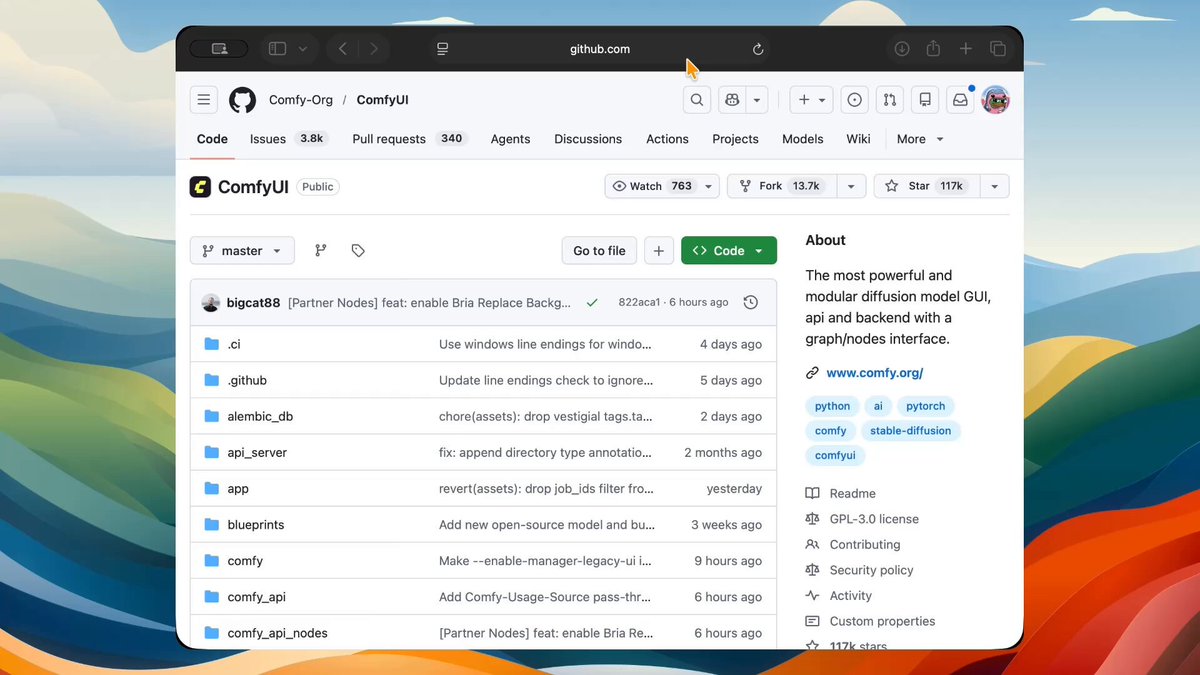
no money for grok or midjourney? this tool is for you. there's a FREE tool created by an anon dev. open-source. runs locally. 117k stars on github. it generates: > images & video > 3d models > audio > 20+ models here's how to set it up in under 5 minutes: 1️⃣download ComfyUI Desktop go to and grab the desktop app for your system. windows 10+, mac (apple silicon), or linux. it installs like any normal app, it sets up python and every dependency for you in the background. no terminal, no config files. 2️⃣open it first launch, it spins up its own environment automatically. you just wait a few seconds and you're in. you'll land on a node canvas, that's the whole interface. 3️⃣load a starter workflow top menu → Workflow → Browse Templates → Image Generation. click it. this drops a ready-made setup onto your canvas so you don't build anything from scratch. 4️⃣grab a model comfyui ships empty on purpose, the model is the brain, and you pick it. in the template, the "Load Checkpoint" node has a Download button when no model is installed. click it. it pulls one in for you (a few GB, this is the only real wait). 5️⃣install ComfyUI Manager this is the one add-on you don't skip. it lets you install models, custom nodes, and updates with a click instead of the command line. grab it from github (link in comments). it's the difference between fighting comfyui and flying in it. one honest note: an NVIDIA gpu makes this fast, apple silicon works great too, and a weak machine still runs it just slower. that's the whole setup. you now own an image, video, and 3D studio that costs you nothing per month. save this. and the next time grok or midjourney asks for your card. you won't need it. disclaimer: comfyui itself is 100% free. so are the local models (sdxl, flux, wan 2.2, ltx-2). some premium models like seedance are pay-per-use api models, only if you want top-tier quality. the free local ones cover most of what you need. (github link in the comments) follow and turn on post notification for daily AI contents.

m0h

14,542 görüntüleme • 2 ay önce

Fable 5 and GPT-5.6 built the same scroll-animated website from 1 skill in 32 minutes and only 1 of them made it feel like a film. Same prompt: boutique Japan travel brand, origami style. A subway pulls in, a paper house unfolds into a hotel, a bird takes flight as you scroll. Doing this by hand is brutal multiple videos, matched starting frames, frames ripped out 1 by 1 and synced to scroll position. The skill does all of it: Generate 1 anchor image and approve it every scene inherits the style Turn it into video through the Higgs Field MCP (Seedance), straight from the terminal FFmpeg pulls every frame Each frame maps to scroll position, so your scrollbar becomes the playhead Setup is just connecting the MCP and loading the skill works in Claude Code and Codex. It interviews you first about scenes, budget and mobile, then shows the anchor image before burning a single credit on video. Budget reality: 6 scenes runs ~800 credits and is overkill, 4 scenes is the sweet spot, crop-safe mobile is the cheap path. The verdict came down to transitions. GPT-5.6 Soul built strong scenes with incredible detail inside each one then hard cuts between scene 1 and 2, and again between 2 and 3. Fable 5 stitched them together: wires push out of the top of frame while the next scene blurs in behind, gains depth and locks into place. Same skill, same prompts, 10 generations each. Credit to Peter Wang for the original Scroll World skill open source, now forked with budget tiers and mobile fixes. Soul built 4 scenes. Fable built 1 film.

Spike 1%

45,354 görüntüleme • 1 ay önce

HE MAKES MONEY IN REAL ESTATE WITHOUT BUYING, SELLING, OR EVEN SEEING A SINGLE HOUSE. HERE'S THE EXACT SETUP He never owns a property. He takes a single listing, turns it into a polished 30-second video, and sells that to the agent who posted it. Realtors need video for their feeds and almost none of them can make it. He sits in the middle and builds the whole thing once as a skill that runs on command Here is the exact process: 1. Pull the listing. Go to Zillow, open any listing, download the high-res images, and grab the property info. That is your raw material 2. Turn photos into video with Google Veo. Get a Google API key for Veo, the image-to-video model. It takes the listing photos and animates them into clean 30-second footage. This is the best one out right now 3. Add the voice with ElevenLabs. Get an ElevenLabs API key. Feed it the listing details and it returns a voiceover that sounds like a real human, not a robot. Lay it over the video with the text on screen 4. Send it with AgentMail. Get an AgentMail key so the system can send the finished email out on its own Then you wire it into one skill. Scrape the listing, send images to Veo, add the ElevenLabs voiceover and on-screen text, then send the email. Feed it each key one at a time and have it build each step Who you sell to: Pull realtors off Zillow and Realtor com whose listings have flat photos and zero video. That gap is your pitch. Send a free sample made from their own listing first, then charge a monthly rate for ongoing clips. One agent with ten listings is a recurring client, fully online Bookmark this

Yarchi

106,174 görüntüleme • 3 ay önce

i built a way to generate realistic AI influencer vlogs without ever touching a camera. this was supposed to stay internal but f*ck it, i'm leaking the entire production system. pick any topic. or paste in a script. a few minutes later you've got a finished influencer-style vlog with: > a consistent AI character > cinematic shots > natural dialogue > realistic iPhone footage > b-roll here's how it works: the workflow first breaks your script into a complete scene-by-scene storyboard with timestamps, camera directions, dialogue, environments, pacing, and shot planning so every clip has a purpose instead of feeling randomly generated. each scene gets its own reference image prompt for Higgsfield that locks the character's identity, clothing, camera angle, lighting, and environment to keep the person looking the same across the entire vlog. those reference images are then animated in Seedance 2.5 using scene-specific prompts that control movement, lip sync, ambient audio, dialogue, camera motion, and timing so every clip feels like it was filmed on an iPhone instead of generated by AI. finally everything gets assembled in CapCut with b-roll, subtitles, transitions, music, pacing, and final polish into a complete vlog that's ready to upload. you're not filming,hiring actors or recording voiceovers. the whole thing goes from idea → finished AI influencer vlog. the document i'm sharing includes: > the complete scene breakdown framework > every Higgsfield image prompt > every Seedance 2.5 animation prompt > dialogue for every scene > b-roll prompts > editing workflow inside capcut > structural notes that make the vlog feel real instead of AI RT + reply "AI VLOG", i'll DM you the entire production blueprint.(must be following so i can DM.)

Sulfur

72,814 görüntüleme • 21 gün önce

🐆 Rapid-MLX v0.12 is here. We’ve officially evolved from a simple chat app into a full-fledged, on-device AI studio for Apple Silicon! 🖥️✨ We didn't just push the MLX inference engine to its limits and expand support for a massive lineup of local open-source models—we are alpha-launching the highly anticipated Desktop Version. (A huge shoutout to the IoTeX community for grinding through the closed beta with us. Your feedback was incredible and helped shape this beast.) Here are the game-changing features you can run on your Mac right now, 100% free and 100% offline 👇 🚀 Blazing Fast Local LLMs Run anything from 4B up to Qwen3.5-122B completely offline. No guessing games—we recommend models matched perfectly to your Mac's actual RAM. Rich chat includes syntax highlighting, markdown tables, and honest tok/s metrics. 🎨 Local Image Generation A brand new Images tab to render directly on your machine. Pick a model (FLUX.2-klein, Z-Image-Turbo), prompt, and refine. Everything lands in a visual filmstrip. 👁️ Vision & Live Web Tools Attach an image and chat about it with local vision. Need real-time data? Our built-in web tools (weather, search, page-fetch) run mid-answer with strict, transparent privacy controls. 🤖 Plug-and-Play Coding Agents Wire up Claude Code, Codex, Cline, or Continue in seconds. One copy-paste from the Launch tab spins up a local OpenAI/Anthropic-compatible endpoint. 🔒 Private by Design Everything runs on-device. Signed, notarized, and entirely local. Your data stays yours. Turn your Mac into an AI powerhouse today. ⚡️

raullen

33,889 görüntüleme • 19 gün önce

- AssetHub officially launched - Using Metahuman Component as parts system in UEFN This is crazy! Just discovered I can use the Metahuman Component in UEFN as a general parts system! Perfect for modular characters. So I had to test it out. First step: character design. With GPT Image 2 I got some really solid characters to work with. These are perfect to test anime/ lowpoly models as well. Gavin Harvey also officially launched so I jumped on a fresh workflow to build the first one. Since I’m aiming for an anime/flat shaded style, I chose Tripo P1 to generate straight to low poly models. Results were perfect for me, UV and textured directly done. Did the main assembly in Blender. I transferred weights onto the new parts (like the jacket here) and used proportional editing to tweak vertices so everything fits together nicely. Then into UEFN / Unreal Engine: For the two-tone shadow look, I made a material that uses the sun direction as a mask. To make all the modular parts work together, I set up a blueprint with the body skeletal mesh as the base, and all the other parts attached as children. Now the really cool part: the Metahuman Component actually lets you plug in extra body parts directly. And every skeletal mesh can have its own Control Rig slot. That means you can layer procedural animations on top of your main animation setup. I used it for procedural eye blinking and hair physics. Since every part is separate, swapping variations is super easy while keeping all animations perfectly synced!

Jerome | InsaneUnreal

24,268 görüntüleme • 3 ay önce

I vibe coded and built a sprite animation pipeline 🛠️ (Day 22 of making the engine+game) ⬇️ Watch the video if you don't wanna read the wall of text - it directly shows what I do. Shoutout to Jidé ✨ for showing me a paper on black/white combination to get alpha, it's the cleanest method yet, and to Cursor for enabling this entire journey. If you prefer the wall of text here you go: The hardest part of using general image models for 2D sprites isn’t getting a nice-looking frame, it’s getting consistent motion across a whole sprite sheet. You can fake a sheet, but frames won’t align, timing drifts, and you end up with weird artifacts. Even if you manually cut frames + interpolate, the animation often looks “off” because each frame is basically a new interpretation, not the same character evolving over time. This is especially noticeable with public API models like gpt-image-1.5 and Nano Banana. Some custom LoRAs for open models exist, but this is intended for less techy folks. My workaround: use a video model first, then post-process into a sprite sheet. Render the animation over a solid background (white/black/magenta/green), then chroma-key it out (my engine tool supports this). If the motion stays inside the silhouette, this works surprisingly well. You can do this in almost any video editing software too! The catch: keying almost always leaves an “aura” (edge spill). My best results come from interpolating the keyed animation with a clean base sprite, so you keep crisp edges and only “borrow” motion/detail where needed. If the animation extends outside the silhouette (tree branches, hair wisps, foliage), I usually skip “true sprite animation” and do it with shaders instead. Keying can’t fully remove halos there, no matter how much feathering/tuning you do. Another annoying issue: pixel corruption. AI rarely generates a perfectly flat background (pure #000000 or #FF00FF). That tiny noise breaks clean extraction and creates crawling garbage pixels around the subject. For clean base sprites (and even PBR maps), a useful trick is generating the same asset on white + black backgrounds and deriving alpha from the difference. This is basically a matte workflow: white = opaque, black = transparent. It fixes aura… but you’d need it per-frame to fix animation, which is still hard. For simple pixel art (single-digit frames), you can sometimes generate a sprite sheet, then ask the model to recreate it on black/white while preserving alignment… but it’s still manual-heavy. Honestly, at this point, for some projects it’s easier to go 3D → 2D and render clean sprites/maps directly. But I still love pushing “pure 2D” and seeing how far we can take it. Thanks for reading! Follow/bookmark/repost if interested in this kind of content!

Startracker 🔺

20,181 görüntüleme • 7 ay önce

Apple's product pages have that scroll effect. The camera flies through a 3D world. Products float. Scenes transition. No cuts. One continuous flight driven by your scroll wheel. Here is what one costs to build in 2026. Big storytelling agencies (Noomo, WithLore, Utsubo): $15,000 to $100,000. Three to six months. A team of designers, 3D artists, and WebGL developers. Awwwards-tier flagship from a senior freelancer: $8,000 minimum. Three.js multi-scene site with GSAP scroll: $3,500 to $8,000. That is if you can find a Three.js specialist. They charge $75 to $150 an hour. There are fewer of them than there are brands that want the site. Now meet scroll-world. A free, open-source agent skill for Claude Code and Codex that generates the entire thing from a prompt. Describe your brand. Describe the scenes. "A coffee brand. Start outside the farm. Fly into the roasting facility. Pass through the packaging. Land in the cafe." It generates the isometric stills. It generates the camera flights. It generates the connector clips between scenes from the actual boundary frames of both neighbors, so every seam is pixel-identical. No flicker. No cut. One continuous flight. Then it wires the chain into a portable vanilla JS scroll engine that drops into plain HTML, Next.js, or Vue. One prompt. Hours. Not months. 6,096 stars on GitHub in 25 days. 724 forks. MIT license. Built by cyw, founder and CTO of Hermai AI, out of San Francisco. Here is what scroll-world does: - Interviews you on brand, scenes, art direction, and budget before spending a cent - Generates the isometric stills through GPT Image 2 - Generates the camera flights through Seedance on Monid - Renders a native 9:16 portrait chain for mobile, not a crop - Ships a vanilla JS scrub engine with blob-seek, lazy load, and seam crossfade - Installs into Claude Code as a plugin or Codex through the Vercel skills CLI - Framework-agnostic Here is what scroll-world costs to install: Zero. Forever. Generation burns credits. A 6-scene 1080p chain on Monid pay-per-clip lands around $27, printed before the run starts. Big storytelling agency: $15,000 to $100,000. scroll-world: $27. Awwwards WebGL flagship: $8,000. scroll-world: $27. Three.js contractor for a month: $12,000. scroll-world: this afternoon. Your brand. Your world. Your scroll. 100% Open Source. (Link in the comments)

Nav Toor

353,967 görüntüleme • 29 gün önce