Video wird geladen...

Video konnte nicht geladen werden

Zur Startseite

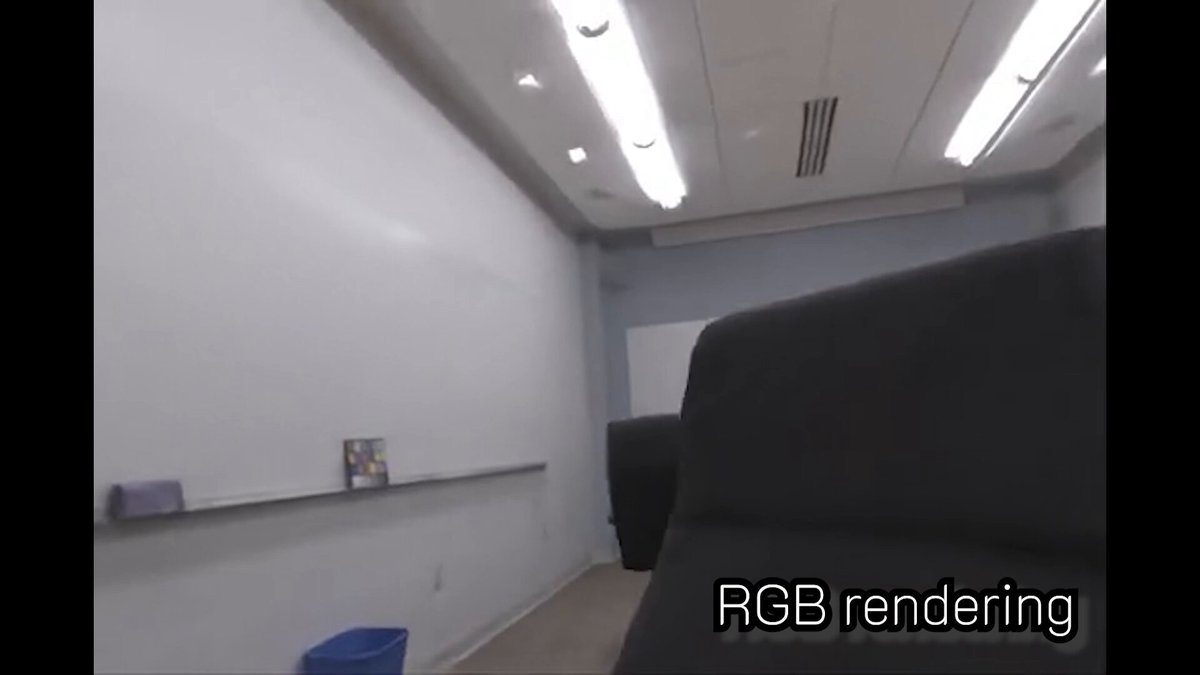
IllumiNeRF 3D Relighting without Inverse Rendering Existing methods for relightable view synthesis -- using a set of images of an object under unknown lighting to recover a 3D representation that can be rendered from novel viewpoints under a target illumination
12,369 Aufrufe • vor 2 Jahren •via X (Twitter)

0 Kommentare

Keine Kommentare verfügbar

Kommentare vom Original-Post werden hier angezeigt

Ähnliche Videos

MaterialFusion Enhancing Inverse Rendering with Material Diffusion Priors discuss: Recent works in inverse rendering have shown promise in using multi-view images of an object to recover shape, albedo, and materials. However, the recovered components often fail to render accurately under new lighting conditions due to the intrinsic challenge of disentangling albedo and material properties from input images. To address this challenge, we introduce MaterialFusion, an enhanced conventional 3D inverse rendering pipeline that incorporates a 2D prior on texture and material properties. We present StableMaterial, a 2D diffusion model prior that refines multi-lit data to estimate the most likely albedo and material from given input appearances. This model is trained on albedo, material, and relit image data derived from a curated dataset of approximately ~12K artist-designed synthetic Blender objects called BlenderVault. we incorporate this diffusion prior with an inverse rendering framework where we use score distillation sampling (SDS) to guide the optimization of the albedo and materials, improving relighting performance in comparison with previous work. We validate MaterialFusion's relighting performance on 4 datasets of synthetic and real objects under diverse illumination conditions, showing our diffusion-aided approach significantly improves the appearance of reconstructed objects under novel lighting conditions. We intend to publicly release our BlenderVault dataset to support further research in this field.

AK

22,949 Aufrufe • vor 1 Jahr

Differentiable Blocks World: Qualitative 3D Decomposition by Rendering Primitives paper page: Given a set of calibrated images of a scene, we present an approach that produces a simple, compact, and actionable 3D world representation by means of 3D primitives. While many approaches focus on recovering high-fidelity 3D scenes, we focus on parsing a scene into mid-level 3D representations made of a small set of textured primitives. Such representations are interpretable, easy to manipulate and suited for physics-based simulations. Moreover, unlike existing primitive decomposition methods that rely on 3D input data, our approach operates directly on images through differentiable rendering. Specifically, we model primitives as textured superquadric meshes and optimize their parameters from scratch with an image rendering loss. We highlight the importance of modeling transparency for each primitive, which is critical for optimization and also enables handling varying numbers of primitives. We show that the resulting textured primitives faithfully reconstruct the input images and accurately model the visible 3D points, while providing amodal shape completions of unseen object regions. We compare our approach to the state of the art on diverse scenes from DTU, and demonstrate its robustness on real-life captures from BlendedMVS and Nerfstudio. We also showcase how our results can be used to effortlessly edit a scene or perform physical simulations.

AK

38,568 Aufrufe • vor 2 Jahren

Blended-NeRF: Zero-Shot Object Generation and Blending in Existing Neural Radiance Fields paper page: Editing a local region or a specific object in a 3D scene represented by a NeRF is challenging, mainly due to the implicit nature of the scene representation. Consistently blending a new realistic object into the scene adds an additional level of difficulty. We present Blended-NeRF, a robust and flexible framework for editing a specific region of interest in an existing NeRF scene, based on text prompts or image patches, along with a 3D ROI box. Our method leverages a pretrained language-image model to steer the synthesis towards a user-provided text prompt or image patch, along with a 3D MLP model initialized on an existing NeRF scene to generate the object and blend it into a specified region in the original scene. We allow local editing by localizing a 3D ROI box in the input scene, and seamlessly blend the content synthesized inside the ROI with the existing scene using a novel volumetric blending technique. To obtain natural looking and view-consistent results, we leverage existing and new geometric priors and 3D augmentations for improving the visual fidelity of the final result. We test our framework both qualitatively and quantitatively on a variety of real 3D scenes and text prompts, demonstrating realistic multi-view consistent results with much flexibility and diversity compared to the baselines. Finally, we show the applicability of our framework for several 3D editing applications, including adding new objects to a scene, removing/replacing/altering existing objects, and texture conversion.

AK

62,768 Aufrufe • vor 2 Jahren