Загрузка видео...

Не удалось загрузить видео

На главную

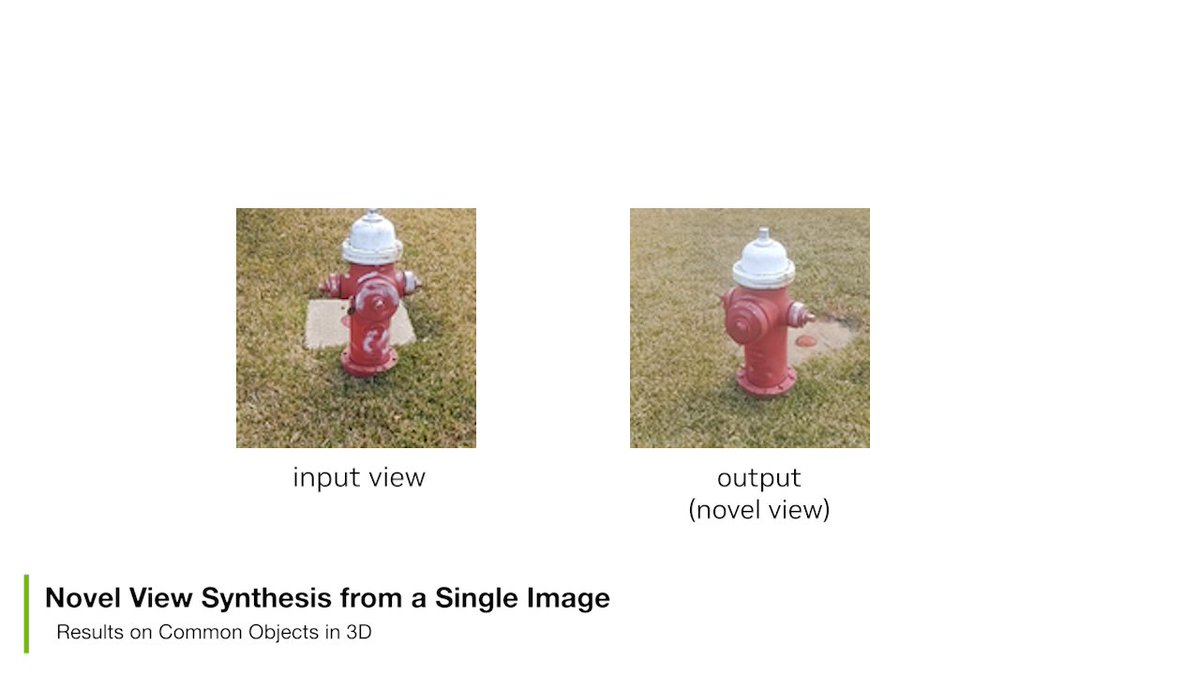
Images rarely show an object’s full 3D geometry. At #ECCV2026, our research team introduced Axolotl3D, a multimodal and occlusion-aware 3D generation model. It combines images, camera data and partial geometry to reconstruct missing regions while preserving observed ones, achieving state-of-the-art results across single- and multi-view settings. Project page:

30,405 просмотров • 5 дней назад •via X (Twitter)

Комментарии: 15

Фото профиля Crypto Abdhul Jackal 🐂🀄
Crypto Abdhul Jackal 🐂🀄5 дней назад

This can create a 3D

Фото профиля James Camarota
James Camarota5 дней назад

So you added depth to images or you generate models. We need a version that’s good at technical car

Фото профиля AI Mastery Guide
AI Mastery Guide5 дней назад

filling in the missing parts, cool tech

Фото профиля Yi Casillas
Yi Casillas5 дней назад

这种 3D 重建如果能稳定保留细小结构,对机器人和数字孪生都很实用。我会特别想看遮挡严重、视角很少时的失败案例。

Фото профиля rishabh
rishabh5 дней назад

Interesting to see the focus on inference efficiency here. The serving details matter as much as the model size.

Фото профиля lewington
lewington5 дней назад

yeah i like this. if youre filling in the parts you cant see, you gotta make sure the parts you can see stay accurate too

Фото профиля Raul Verdusco
Raul Verdusco5 дней назад

Reconstructing what a camera cannot see is a major challenge for 3D perception.Occlusion-aware models like this could strengthen digital twins, simulation, and robotics by creating more complete representations from limited visual data. 🤖📐

Фото профиля freesoul
freesoul5 дней назад

Strong fit for robotics and digital twins if the completed mesh stays watertight and physically plausible under simulation.

Фото профиля Gabriele Spata
Gabriele Spata5 дней назад

every 3D completion demo looks great on the axolotl and the dragon, ask me about the object nobody picked for the slide

Фото профиля Paul · SpellWright
Paul · SpellWright5 дней назад

This is a nice fit for asset cleanup. I’m curious how much camera metadata quality affects the reconstruction—does it fail gracefully with sparse input geometry, or just hallucinate detail?

Фото профиля Trevor Knott
Trevor Knott5 дней назад

📝

Фото профиля disorderly
disorderly5 дней назад

AI is slowly learnin that reality doesnt stop where the camera stops

Фото профиля Yi Casillas
Yi Casillas5 дней назад

这 3D 重建我很关心“没看到的部分”怎么处理只在单视图上看起来完整还不够最好能把遮挡区的置信度也出来;游做编或仿真时,知道哪里是猜的会差很。

Фото профиля BullBear.News
BullBear.News5 дней назад

handling partial geometry without blowing up inference latency is the real hurdle here

Фото профиля Rakesh Gohel 🇨🇦
Rakesh Gohel 🇨🇦5 дней назад

This is a major step for 3D AI. Reconstructing hidden geometry while preserving what’s actually observed could unlock powerful new workflows across vision, robotics, and simulation.

Похожие видео

Differentiable Blocks World: Qualitative 3D Decomposition by Rendering Primitives paper page: Given a set of calibrated images of a scene, we present an approach that produces a simple, compact, and actionable 3D world representation by means of 3D primitives. While many approaches focus on recovering high-fidelity 3D scenes, we focus on parsing a scene into mid-level 3D representations made of a small set of textured primitives. Such representations are interpretable, easy to manipulate and suited for physics-based simulations. Moreover, unlike existing primitive decomposition methods that rely on 3D input data, our approach operates directly on images through differentiable rendering. Specifically, we model primitives as textured superquadric meshes and optimize their parameters from scratch with an image rendering loss. We highlight the importance of modeling transparency for each primitive, which is critical for optimization and also enables handling varying numbers of primitives. We show that the resulting textured primitives faithfully reconstruct the input images and accurately model the visible 3D points, while providing amodal shape completions of unseen object regions. We compare our approach to the state of the art on diverse scenes from DTU, and demonstrate its robustness on real-life captures from BlendedMVS and Nerfstudio. We also showcase how our results can be used to effortlessly edit a scene or perform physical simulations.

AK

38,571 просмотров • 3 лет назад

DreamCraft3D: Hierarchical 3D Generation with Bootstrapped Diffusion Prior paper page: present DreamCraft3D, a hierarchical 3D content generation method that produces high-fidelity and coherent 3D objects. We tackle the problem by leveraging a 2D reference image to guide the stages of geometry sculpting and texture boosting. A central focus of this work is to address the consistency issue that existing works encounter. To sculpt geometries that render coherently, we perform score distillation sampling via a view-dependent diffusion model. This 3D prior, alongside several training strategies, prioritizes the geometry consistency but compromises the texture fidelity. We further propose Bootstrapped Score Distillation to specifically boost the texture. We train a personalized diffusion model, Dreambooth, on the augmented renderings of the scene, imbuing it with 3D knowledge of the scene being optimized. The score distillation from this 3D-aware diffusion prior provides view-consistent guidance for the scene. Notably, through an alternating optimization of the diffusion prior and 3D scene representation, we achieve mutually reinforcing improvements: the optimized 3D scene aids in training the scene-specific diffusion model, which offers increasingly view-consistent guidance for 3D optimization. The optimization is thus bootstrapped and leads to substantial texture boosting. With tailored 3D priors throughout the hierarchical generation, DreamCraft3D generates coherent 3D objects with photorealistic renderings, advancing the state-of-the-art in 3D content generation.

AK

161,530 просмотров • 2 лет назад

3D-LLM: Injecting the 3D World into Large Language Models paper page: Large language models (LLMs) and Vision-Language Models (VLMs) have been proven to excel at multiple tasks, such as commonsense reasoning. Powerful as these models can be, they are not grounded in the 3D physical world, which involves richer concepts such as spatial relationships, affordances, physics, layout, and so on. In this work, we propose to inject the 3D world into large language models and introduce a whole new family of 3D-LLMs. Specifically, 3D-LLMs can take 3D point clouds and their features as input and perform a diverse set of 3D-related tasks, including captioning, dense captioning, 3D question answering, task decomposition, 3D grounding, 3D-assisted dialog, navigation, and so on. Using three types of prompting mechanisms that we design, we are able to collect over 300k 3D-language data covering these tasks. To efficiently train 3D-LLMs, we first utilize a 3D feature extractor that obtains 3D features from rendered multi- view images. Then, we use 2D VLMs as our backbones to train our 3D-LLMs. By introducing a 3D localization mechanism, 3D-LLMs can better capture 3D spatial information. Experiments on ScanQA show that our model outperforms state-of-the-art baselines by a large margin (e.g., the BLEU-1 score surpasses state-of-the-art score by 9%). Furthermore, experiments on our held-in datasets for 3D captioning, task composition, and 3D-assisted dialogue show that our model outperforms 2D VLMs. Qualitative examples also show that our model could perform more tasks beyond the scope of existing LLMs and VLMs.

AK

249,798 просмотров • 3 лет назад