正在加载视频...

视频加载失败

Instead of using UE, I built my own Vulkan engine for full control over rendering and memory. Features: - Data-driven rendering - Preallocated arenas, no runtime heap - Cascaded shadow maps - Temporal AA Currently building a fully 3D voxel GUI. #cubeworld #vulkan

448,322 次观看 • 1 年前 •via X (Twitter)

31 条评论

TBGlitch RDC2026 的头像
TBGlitch RDC20261 年前

HE LIVES

Squreek 的头像
Squreek1 年前

Cubeworld post in 2025‽

🌊Inumi Gessui🍦 | The All-Devouring Wolf【VCAN】 的头像
🌊Inumi Gessui🍦 | The All-Devouring Wolf【VCAN】1 年前

Holy shit you still working on this? I mean it's cool and all that you're working on the GUI, but there are a LOT more that needs your attention. Give us back XP from mobs so we can level up, remove the region lock system for weapon/armor/specials, remove the stats debuffs when out of region (due to region lock system removal) and make it so that the further you are from spawn region the mobs become stronger (Ex: spawn region 1-10, region that share a border with spawn region 11-20 and so on) with at a certain point having the mobs scale based on player level (This will allow players to keep having challenging regions). These are the 4 things that comes to mind, but i'm sure there are more.

47 的头像
471 年前

its over bro let it go

carter 的头像
carter1 年前

So, you’ve gone from Picroma Picroma 2 UE5 and now Vulkan? Dude can you just give it up? You’ve been gaslighting me for 13 years.

HefTheNottyCoon (Commissions always open!) 的头像
HefTheNottyCoon (Commissions always open!)1 年前

Look who's back from the dead! Out of funds again, buddy?

Gent Lemann 的头像
Gent Lemann1 年前

Holy shit. You're alive?

The Open Mat Show 的头像
The Open Mat Show1 年前

Holy shit 🙏🙏😭😭

Dreadric 的头像
Dreadric1 年前

Thank you for all the work you're doing, we might complain about a lot, but we still believe in you and your work.

SAROCK🦝🧷 的头像
SAROCK🦝🧷1 年前

Cube world, my beloved ♥️ Until we couldn't explore due to the region locked gear & levels ;_;

Dshoopy 🇺🇸 的头像
Dshoopy 🇺🇸1 年前

Wollay, please bring this to completion then get into a content release cycle, that is all we ask for.

WhiteRice 的头像
WhiteRice1 年前

He lives??

©soba 的头像
©soba1 年前

its been a WHILE since i got a notification from this account, glad you’re still working on cube world, much love!!

Marty 的头像
Marty1 年前

Are you remaking cube world? Because that game was destined for greatness

Bitkoning 的头像
Bitkoning1 年前

You launched around the same time Minecraft came to life. You could have been a multi millionaire or even billionaire if you weren't a dickhead. Idiot. Accept help or stay consistent. Scammer fucker.

iRaphahell 的头像
iRaphahell1 年前

What's the expected release date? 2030-2040?

Tripalink 的头像
Tripalink1 年前

This stuff is cool. But this isn't what's needed. What's needed is game design upgrades. Can't just update the graphics and release another mess. Gotta switch out the time your spending on the graphics and research game design when your making... a game

ultimacommanderofautism 的头像
ultimacommanderofautism1 年前

how many times can he scam the same playerbase?

Sree 的头像
Sree1 年前

a lot of people won't get how insane this is. genuinely fire, and it looks so smooth too🔥

Joffrey_00 的头像
Joffrey_001 年前

Wollay mindset: make only one update in july 2013 with low content, take holidays 6 years and resold game on steam with one update, take holidays 4 years no update, take holidays 1 year no update In 2025 most steam games released and abandoned it's normal I ❤️ CW but its 💼

RathGames 的头像
RathGames1 年前

He returns once more

Elias Maks 的头像
Elias Maks1 年前

VAMO LOCOO VOLVIÓ VAAAAMOOOSS

ArkDev 的头像
ArkDev1 年前

Sounds like a nightmare

SquidyBandit 的头像
SquidyBandit1 年前

All of us here since day 1 knowing exactly how this turns out:

edward L rizz 的头像
edward L rizz1 年前

I love cube world!!!!!

AbelsFables 的头像
AbelsFables1 年前

Had high hopes for cubeworld but this point pretty sure ur just a scammer grabbing money from people. I had the original back in the day. Got the steam version which was hot garbage compared to the original and now another possible release? No thanks.

Tomcat 的头像
Tomcat1 年前

absolute mad lad

🐉 D. G. Jagielski 🐉 的头像
🐉 D. G. Jagielski 🐉1 年前

If you make this good, I'm ready to change my opinion about you and will spread the good news everywhere I can. For now though, I will be playing Veloren.

Anatolii 的头像
Anatolii1 年前

oh damn. I loved that game, played it 1-2 months non-stop when it came out. Was sad to see the development slow down at the time. Super excited to try it out again :)

The Tin Bull 的头像
The Tin Bull1 年前

Is it time to rehype an old dead product to make millions more just to run off again? So many years later and you're still "working" on rendering. You managed to scam quite a few people before, but I doubt it works again.

Sanuary 的头像
Sanuary1 年前

Was just thinking about Cube World not too long ago. Glad to see more progress! 👍

相关视频

Hi Friends, for my first project created with GPT-6 Astra, I built the entire city of Seoul in 3D—a small revolution in digital geography! 😄 This interactive 3D miniature covers all of Seoul and its surrounding areas, and you can explore it yourself. It includes: • All 25 districts of Seoul and approximately 267,000 simplified building models • Rotate, zoom, and pan controls, plus an automated fly-through of 14 landmarks • Day, sunset, and night modes • Mobile touch support The buildings were generated from real-world map data, with their shapes simplified for performance. Terrain and building heights are exaggerated by 4× to make the cityscape easier to see. The entire process—from creating the project to completing deployment—took 43 minutes and 38 seconds minutes. Please note that the buildings are simplified models based on locations and footprints recorded in OpenStreetMap. Where height data is unavailable, estimated heights derived from the source data are used. The landmark models are interpretive recreations designed to emphasize their distinctive features, rather than survey-grade or photorealistic reconstructions of every building. The project is based on real road, waterway, elevation, and building data. • Maps and buildings: OpenFreeMap / OpenMapTiles / © OpenStreetMap contributors · ODbL Data snapshot: August 30, 2026 • Terrain: AWS Terrain Tiles / Mapzen · SRTM and other sources • District boundaries: southkorea/seoul-maps · Statistics Korea’s 2013 boundaries These may differ from Seoul’s current administrative boundaries. • 3D rendering: Three.js • Additional components: terrain, road, and building data, subject to their respective licenses

synabreu

336,130 次观看 • 13 天前

I built a Three.js rendering study inspired by Tiny Glade’s painterly aesthetic, and got it running at 120fps in the browser. Over the past few weeks, I’ve been studying how stylized games achieve that soft, handcrafted look in real time. Tiny Glade was a huge inspiration, and I wanted to use the browser as a constraint: no compute shaders, no native GPU access, and single-threaded JavaScript. As part of this study, I implemented: - GPU-driven instanced brick walls with procedural noise jitter and elastic build animations - Tree, bush, and flower rendering with billboard card expansion, wind sway, and grow animations - Procedural grass with terrain conformance and interactive push deformation - Animated water with layered noise, interactive ripples, and Fresnel-based reflections - Procedural terrain with slope-aware triplanar materials, dirt paths, and rocks - A 7-pass post-processing stack with TAA, bloom, depth of field, painterly filtering, ACES tonemapping, 3D LUT color grading, and film grain The hardest part wasn’t writing any single shader. It was making all of these systems work together at high frame rates inside WebGL, where every millisecond counts and performance problems compound quickly across animation, materials, post-processing, and scene management. Some techniques in this study were inspired by analyzing Tiny Glade’s rendering approach, while others were original implementations built from scratch from visual reference. That contrast taught me a lot: recreating an effect is one challenge, but designing your own shaders and systems to achieve a similar feel is a very different one. This is a private educational rendering study. Some temporary placeholder content is being used during the research phase, and any public or production version would use original or properly licensed assets. Huge credit to Pounce Light for the incredible art direction and rendering work in Tiny Glade: Three.js #gamedev #webgl #threejs #rendering #graphics #realtimerendering #shaderdev

Ibrahim Boona

58,625 次观看 • 5 个月前

Working on Sparse Volumetric Light-maps. Thanks to CynicatPro🎃 for pointing me at Unreal's version. In a nutshell it's just another sparse voxel data structure. My implementation is, no doubt, different from Epic Games Store's own. I'm using 4x4x4 probe grid with intermediate nodes having very wide branching factor of 64 as well (4x4x4). I liked the parameters that Unreal is using, of limiting both total memory as well as the lowest level of detail, which is common in sparse grid implementations. Here's Bistro scene with just 1Mb limit. This is roughly equivalent to a 512x512 lightmap texture in 2d, except surface light maps require unique UVs and you typically get very little detail out of 512 resolution texture with a lot of light leaking. There is also no directional response. My implementation encodes second-order spherical harmonics for each probe (9 coefficients), encoding RGB channels as RGBE9995 (4 bytes). So far only worked on the structure, actual bake is yet to come. I've been eyeing sparse voxel structures for a while now, and have been studying them roughly since the GigaVoxel paper by Cyril Crassin but never really implemented anything for the GPU before. I was always the BVH-kind of guy. It's a fascinating topic. --- Stats for the scene: --- Total memory usage: 1.000 MB Node count: 609 Unique probe count: 24,025 Probe reuse: 38.36 % Unexpanded nodes: 15,714 --- Again, note that there is no GI going on here, only the structure of the probe tree and the algorithm for building it from a given scene.

Alex Goldring

11,519 次观看 • 7 个月前

** Sega Genesis 3D engine update 8.5 ** A smaller update - Scrolling left or right of the sprite based background is implemented along with X camera shifting of the 3d plane. The Exodus emulator has been used with sprite boxing enabled so you can see the background sprites making up the object ( their outlines ) and how they move to tilt the image . The background is made up of 112 sprites (51 are multiplexed in that number as the Genesis is limited to 80 without mulitplexing eg basically re-using sprite hardware as the screen is being drawn ) . In a 6 x 17 sprite grid of 16x32 pixel high sprites. If the tilt affect was not neccessary or only 1/2 the angle of tilt effect was needed, I could get away with 1/2 the number of sprites and just used 32x32 sprites instead. I think the tilt effect adds a bit to movement however. This is very similar to how a Neo Geo would build its backgrounds up - in 16 pixel strips however its sprites are tall as the screen or more but the concept of making backgrounds up in 16 pixel wide strips is similar. The NG uses sprites to build any background layers required. Here on the Genesis the reason is rendering is much faster using both the 3d planes and using a total sprite background for this engine. Initially i had a lot of things breaking when I tried to move the camera in the X dimension much , as i'd optimised the vertex transform path heavily and once beyond a certain camera offset the X value was wrapping around causing a lot of breakage in the rendering. Thankfully solved that issue without marginal impact to cpu . It still needs work , perspectives are a bit wrong etc but it won't be hard to fix. Also found some rendering speeds ups, about 8% by optimising fully onscreen quads and optimising the clearing of the frame buffers more efficiently. Toni Gálvez - Megastyle - BG. has been hard at work on HUD elements and more 3d models so will have something to show for that soon. #SGDK #SegaMegadrive #SegaGenesis

Shannon Birt

21,468 次观看 • 1 个月前

Introducing Aval - a new open source format for interactive video on the web. It has a built-in state machine, frame accurate transitions, and packed alpha transparency. This is probably the craziest thing I’ve ever built with Codex. I’d been dreaming about this technology for years. Before AI, building it would have taken months of work. I could never justify that investment for a noncommercial open source project. Then, a little over a year ago, Airbnb created Lava for almost exactly the same purpose. That gave me hope. But Lava was never released as open source. So I decided to build my own, with AI. Aval comes with a compiler and a web renderer. Together, they give you: • a deterministic state graph - named states, authored triggers, and routing where the latest trigger wins. • frame accurate routes with transitions that begin on authored content frames using portals, finishes, cuts, and reversals. • small file size and low CPU overhead, perfect for small icons designed and animated in Blender. • seekless loops so the decoder timeline keeps moving forward across loop seams instead of seeking. • packed alpha transparency. transparent prerendered motion composited with WebGL2. • a web native runtime: decoding with WebCodecs and rendering with WebGL2. • progressive fallback: Host-owned fallback markup remains available for unsupported and reduced motion contexts. Now it exists, it’s open source, and it’s available today as a technical preview. I’ll be polishing it further over the next few days.

Alex Barashkov

276,846 次观看 • 2 个月前

I spent 20 years architecting AAA game engines, going back to the PlayStation 1. I wrote all of that by hand. This one I did not. It is a stylized real time digital twin of the SF Bay Area, built from scratch in C++ and Vulkan. The geometry is real, the look is not. It is meant to read as a painted model of the Bay rather than a photo of it, because a photoreal copy of a place you can already see from a satellite is not worth building. The world is an 80 km square, about 6,400 km², and all of it is built from open data. USGS 3DEP 1 m lidar for the terrain. NOAA CoNED for the bay floor. USGS NHD for water. ESA WorldCover for land cover. OpenStreetMap for footprints and roads. That comes to 13 GB of streamed tiles, and 9.8 GB of it is terrain. Past the edge there is a 420 km coarse ring on Copernicus GLO-30, so the horizon does not end at a flat edge. Distant ridgelines bend down below it. There are 424,787 real building footprints in there, extruded procedurally, with heights off OSM tags and a plausibility gate that drops anything whose tagged height will not fit its own footprint. Across the whole 80 km box it rejects exactly 8 buildings, four of them towers carrying a bad height tag that used to extrude as needles over a derelict pier at Hunters Point. On top sit 41 landmarks at their real coordinates, authored by Fable as parametric Blender scripts rather than sculpted: Golden Gate, Transamerica, Coit, Sutro, Salesforce, the Ferry Building. Each one switches off the generated building underneath it. The simulation is the actual point. A 24 hour recording of real feeds plays back on a clock inside the app, at 1x up to 2000x. Caltrans PeMS for highway flow, 511 for Caltrain, OpenSky for flights, AIS for boats, METAR at SFO, OAK and SJC, and HRRR for weather. 165,356 samples across those 8 feeds. Cars spawn at the volume PeMS measured on that segment. Trains run the delays 511 reported. Planes fly the tracks OpenSky recorded. It is replay, not a live stream. Live polling is next and feeds the same clock, so it is a source swap rather than a rewrite. There is also a globe. You pick the Bay from orbit, fly down to the surface, and back out again. Reversed Z depth, HDR with a filmic tonemap, dual filter bloom, a time of day grade, and a volumetric marine layer for Karl the fog. AI agents write the issues, set the constraints, make the art direction calls, and review and validate every line of the roughly 235,000 lines of C++, GLSL, Python and PowerShell. What I built is the orchestration that holds it together, and the judgement on top of it: what to build, what to cut, and when to accept the result. The language choice is doing real work here. The hard part of AI written software is not producing the code. It is proving the code is right. C++ and Vulkan are unusually good at that, because nothing is hidden: every resource, every frame, every buffer you can read back. 28 golden image scenes compared by SSIM. An MCP server that drives the running app, so an agent can move the camera, set a sky preset, take a screenshot, and read the streaming counters back out. It validates against a live process instead of against its own diff. And a reviewer agent whose only job is to work out what the issue asked for before it reads the summary the PR wrote about itself. So I think C++ and Vulkan stay the heavy duty layer through the AI era. Not in spite of being low level. Because being performant, deterministic and checkable is exactly what an agent loop needs to push against. A managed engine hides the state that verification depends on. This is a hobby project, and it has nothing to do with my day job. Clips are below. More as I go. Map data © OpenStreetMap contributors (ODbL). Land cover: ESA WorldCover 2021 (CC BY 4.0). Terrain: USGS 3DEP and NOAA. Flight data: OpenSky Network. #Vulkan #cpp #gamedev #digitaltwin #OpenStreetMap

Xiang Wei

79,279 次观看 • 1 个月前

BREAKING - EARLY EXCLUSIVE: XPENG Partners with Google Maps to Fuel Global Expansion The global autonomous driving landscape is becoming even more competitive! XPENG has announced a milestone global partnership with Google Maps, bringing a complete refresh of its in-car navigation and advanced driver assistance systems (ADAS). This major upgrade will come standard in the newly debuted XPENG L03. At the official launch event for the L03 in Munich, Germany, XPENG Chairman and CEO He Xiaopeng announced that the Next-Gen AI SUV Coupe will launch simultaneously in 64 countries and regions. XPENG is building its native in-car navigation system using Google Maps’ Auto SDK for vehicles outside China, which I’m sure MANY of you will be excited about. First in APAC to Adopt Google Maps Auto SDK XPENG is the first automaker from the APAC region to ship a vehicle with Google Maps Auto SDK integration. Instead of using your smartphone for basic screen mirroring, drivers get a native, custom in-car map application designed entirely by XPENG and powered directly by Google Maps. This integration brings: Real-time precision: Live traffic-aware guidance and highly accurate place search. Smart EV routing: Direct in-car EV energy estimation and trip planning. Native control: Full compatibility with voice control and multi-screen display transfer. Laying the Foundation for Global Autonomous Driving This partnership goes beyond finding directions. XPENG is officially utilizing Google Maps' in-vehicle Map Data Services to support its flagship full-scenario ADAS, Next Generation Pilot (NGP), as well as its foundational assist system, XPILOT ASSIST. To scale XPENG's advanced driving systems internationally, future applications of NGP (VLA 2.0) must rely on highly accurate map data and navigation maneuvers. Google Map Data Services will serve as the cornerstone for this phased global rollout, excluding markets in the Commonwealth of Independent States (CIS). Think of it as a fusion of XPENG’s technology with Google Maps Technology to get a more robust, intelligent, powerful, and safe autonomous driving experience. Overseas users of the XPENG L03 will be the very first to experience this upgraded, Google-powered native navigation system. My Thoughts I personally love and use Google Maps, so I’m glad to see this partnership, and I find it really neat how XPENG and Google Maps technology will work together. What are your thoughts and questions on XPENG integrating Google Maps natively to power its global self-driving tech? Let me know in the replies, and I will try to find the answers to your questions.

M. Brandon Lee | THIS IS TECH TODAY

65,878 次观看 • 2 个月前

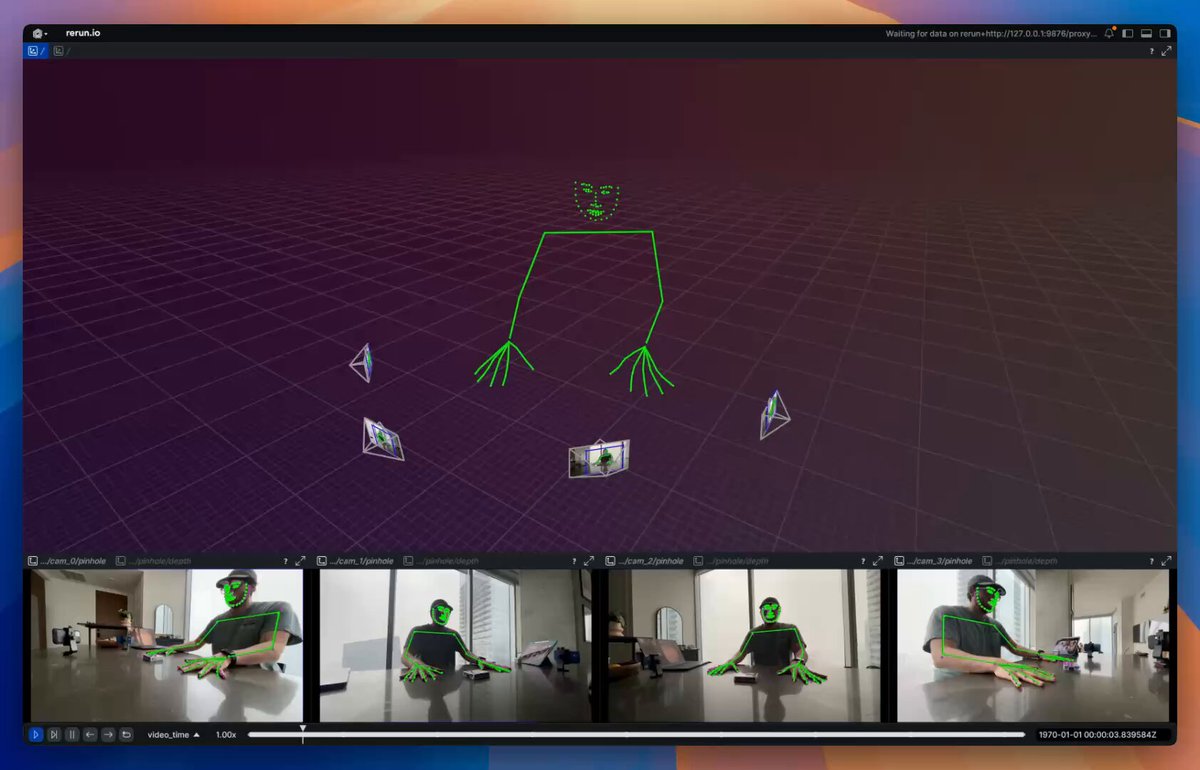
MVP of Multiview Video → Camera parameters + 3D keypoints. Visualized with Rerun The basic pipeline as of right now looks like this: 1. Capture 🔴 – Using 4 iPhones and an Insta360 Go. iPhone videos are captured via Final Cut Pro Multicam for easy sync and the exocentric view; the Insta360 Go is used for the egocentric view. 2. Sync 🕒 – Custom Gradio app using two Rerun viewers and callbacks for easily aligning frame timestamps so the ego and exo views are aligned. 3. Calibrate 🎯 – Use VGGT from Jianyuan and AI at Meta to get intrinsics/extrinsics for sparse cameras. 4. Estimate 3D 🕺 – Use RTMLib whole‑body keypoint estimator on each frame, then triangulate in 3D. What's missing? 1. No temporal coherence: I’m estimating keypoints one frame at a time and one camera at a time. This leads to a lot of jittering. For now, I plan on adding a One Euro Filter to help with jittering. Long term, I'd want to train a multiview keypoint estimator 2. Kinematic fitting is still missing; this is my next goal. The output will be joint angles, as explored in my previous posts. 3. Missing dense point cloud: VGGT seems to fail for me here. I’m looking to explore using MP‑SFM as a method for generating dense multiview depth maps + normals (plus it has a friendlier license compared to VGGT). 4. Eventually, creation of 4D Gaussian splatting using something akin to DN‑splatter—my long‑term goal is a data engine that provides poses/depths/splats/keypoints/etc.

Pablo Vela

42,785 次观看 • 1 年前